
Coastal forest conservation, sable antelope protection, elephant pressure, waterfalls, and biodiversity on Kenya’s south coast
Shimba Hills National Reserve is one of the most ecologically distinctive protected areas in Kenya. It is not an open plains park in the style of the Masai Mara, nor a classic lake sanctuary like Lake Nakuru. It is a coastal forest-and-grassland reserve in Kwale County, just inland from the Indian Ocean, where steep hills, closed-canopy forest, grassland openings, wetlands, and river valleys support one of the most unusual conservation assemblages in East Africa. Kenya Wildlife Service describes it as one of the largest coastal rainforests in the region and the last breeding herd of the rare sable antelope in Kenya.
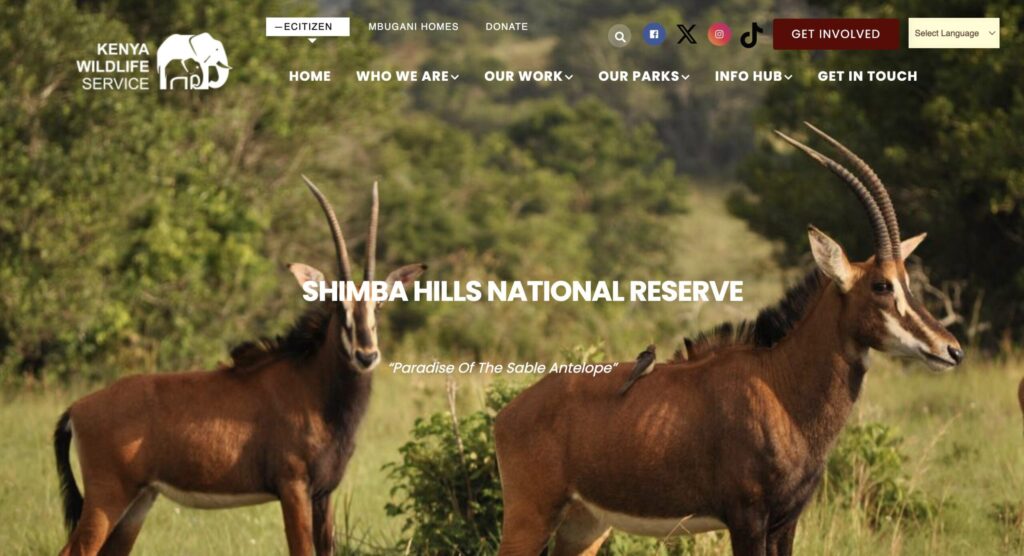
What makes Shimba Hills important is not simply that wildlife occurs there. Its importance lies in the fact that it protects a rare coastal forest ecosystem, supports one of Kenya’s most localized and conservation-sensitive large-mammal populations, holds exceptional botanical and invertebrate richness, and functions as an important freshwater catchment for the wider coast as explained in the Reserve’s Keybiodiversity Profile.
⭐ Overview of Shimba Hills National Reserve
Shimba Hills is best understood through five overlapping identities:
- A coastal forest reserve rather than a classic savannah park.
- Kenya’s only population and last breeding herd of sable antelope, the reserve’s signature conservation feature.
- A high-elephant-density landscape, where herbivore pressure is itself a major ecological management issue.
- A biodiversity-rich coastal-forest mosaic with rare plants, butterflies, amphibians, birds, and small mammals.
- A hydrological refuge whose rivers help supply freshwater to Mombasa and the Diani–Ukunda area.
📍 Location, Geography, and Physical Setting
Shimba Hills National Reserve lies in Kwale County, about 30 km south-west of Mombasa and just south of Kwale town, on a dissected upland plateau rising above the coastal plain. The Key Biodiversity Areas factsheet describes the escarpment as rising from around 120 m to about 300 m across much of the plateau, reaching roughly 450 m at the higher hills.
This topography is one of the reserve’s defining ecological features. Shimba Hills is not flat country. It is a folded, broken, and elevated coastal landscape of hills, escarpments, ravines, forest blocks, glades, drainage lines, and grassland pockets. That structure influences everything else: temperature, mist, forest persistence, water flow, animal distribution, and visitor experience. KWS notes that the climate is hot and moist but cooler than the coast, with strong sea breezes, frequent early-morning mist, annual rainfall of 855–1682 mm, and a mean annual temperature of about 24.2°C.
🧭 Why Shimba Hills Matters
Shimba Hills matters because coastal forests are among the most reduced and fragmented ecosystems in eastern Africa. UNESCO’s Tentative List description of the Coastal Forests of Kenya places Shimba Hills within a wider biodiversity hotspot and notes its exceptional flora and fauna, including Kenya’s only sable antelope population and very high plant diversity.
This means the reserve should not be interpreted merely as a scenic coastal excursion. It is a refuge for a diminishing biome. In analytical terms, Shimba Hills represents a conservation landscape where forest persistence, grassland retention, large-herbivore management, water security, and endemic biodiversity all intersect in a relatively small area.
📐 Size, Habitat Composition, and Spatial Character
Shimba Hills is compact by Kenyan protected-area standards, but ecologically dense. The Key Biodiversity Areas factsheet describes the reserve and associated ecosystem as containing a habitat mosaic that is approximately:
| Habitat Type | Approximate Coverage |
|---|---|
| Forest | 45% |
| Shrubland | 35% |
| Grassland | 16% |
These figures matter because they explain why the reserve is so biologically rich. Shimba Hills is not a single habitat dominated by one ecological process. It is a mosaic reserve, and that habitat heterogeneity is a major reason why it supports forest birds, open-country species, elephants, sable antelope, rare amphibians, high butterfly diversity, and unusually rich plant communities in the same landscape.
🦌 Sable Antelope: The Reserve’s Flagship Species
The single most important species-identity link for Shimba Hills is the sable antelope (Hippotragus niger). KWS states that the reserve holds the last breeding herd of the rare sable antelope in Kenya, while both the KBA and UNESCO descriptions emphasize that this is Kenya’s only population of the species and that protecting grassland within the reserve was a major reason those areas were incorporated into the protected system.
That fact gives Shimba Hills a national conservation role that goes far beyond tourism. In many reserves, a flagship species is important but replaceable within a larger national range. In Shimba Hills, the sable antelope is structurally different: it is a singular national population, which means local habitat condition, grassland management, disturbance, and predator–prey balance all matter at a much higher strategic level.
KWS also notes that sable antelope are highly matriarchal, typically forming herds of 15–20 individuals led by a dominant female. That social structure is not just a natural-history curiosity; it matters for monitoring and population management, because breeding stability and herd composition are central to long-term viability in a small, isolated population.
🐘 Elephants and Ecological Pressure
Shimba Hills is also widely known for its elephants. UNESCO’s Tentative List text says the reserve hosts the highest density of African elephants in Kenya, while the KBA factsheet notes substantial elephant numbers and highlights the ecological consequences of confining a large browsing population in a restricted forest-grassland system.
This is one of the reserve’s most important conservation tensions. Elephant presence is often celebrated in tourism narratives, but in Shimba Hills the conservation question is not simply whether elephants are present. It is whether their density, movement constraints, and browsing pressure are compatible with the long-term persistence of sensitive forest habitats and regeneration dynamics. The KBA factsheet explicitly notes that regeneration in some logged-over forests appears to be inhibited by the large, increasingly confined elephant population, which uses forest for cover during the day and emerges at night to feed in grasslands and raid farms outside the reserve.
That makes Shimba Hills a strong example of a broader conservation truth: species protection is not always only about increasing numbers. In some landscapes, it is equally about managing ecological balance inside a finite protected area.
🌳 Forest Ecology and Coastal Biodiversity
Shimba Hills is one of Kenya’s most important coastal-forest landscapes. UNESCO’s Tentative List description and the KBA factsheet both emphasize its richness in flora and fauna, while KWS itself frames the reserve as one of the region’s largest coastal rainforests.
The reserve’s ecological significance rests on more than one habitat type. It contains:
- closed-canopy forest
- forest–scrub mosaics
- grassland openings
- wet valleys and drainage systems
- escarpment and hilltop habitats
This habitat diversity is why the reserve supports such a broad taxonomic range. It is also why Shimba Hills matters as a coastal refuge system rather than merely a mammal reserve. Forest continuity, patch quality, and edge condition are fundamental conservation concerns here.
🌿 Plants, Endemism, and Botanical Importance
Shimba Hills is exceptionally important botanically. The KBA factsheet states that about 1,100 plant taxa have been recorded in the area, roughly 280 of them endemic to the Shimba Hills area, with nearly 20% considered rare globally or in Kenya. It notes that this qualifies Shimba as a Centre of Plant Diversity.
This is a major point of uniqueness. Many Kenyan parks are known mainly through large-mammal tourism. Shimba Hills has that layer, but its deeper conservation identity is also botanical. In scientific terms, a reserve with this degree of plant richness and rarity is protecting not only scenery or charismatic animals, but evolutionary distinctiveness, habitat structure, and ecosystem resilience.
🐦 Birds, Butterflies, Amphibians, and Lesser-Known Diversity
Shimba Hills should also be understood as a reserve of small-range and non-charismatic biodiversity, not only elephants and antelope. The KBA factsheet highlights regionally threatened bird species, valuable grassland bird habitat, and seasonal concentrations of Palearctic migrants. It also reports about 295 butterfly species, roughly 35% of Kenya’s total, including rare and endemic taxa.
The same source identifies two frog species, Afrixalus sylvaticus and Hyperolius rubrovermiculatus, as endemic to the Shimba Hills forests and believed to be endangered, while UNESCO also highlights these amphibians and the occurrence of the range-restricted caecilian Boulengerula in the reserve.
Herpetological research adds another layer. A 2018 synthesis described Shimba Hills as the richest herpetofauna area in Kenya, with about 89 reptile species and 36–38 amphibian species, depending on the database summary cited. Even allowing for variation between reporting sources, the core conclusion is stable: Shimba Hills is a major national center of reptile and amphibian diversity.
💧 Water Catchment, Rivers, and Coastal Environmental Services
One of the most important but underappreciated aspects of Shimba Hills is its role in regional water security. The KBA factsheet states that rivers flowing from the hills supply fresh water to Mombasa and to the Diani/Ukunda area, and the 2024–2034 ecosystem management plan summary likewise describes the ecosystem as an important freshwater source for Kwale and Mombasa towns, Ukunda/Diani, and Kinango.
That fact changes how the reserve should be written about. Shimba Hills is not only a wildlife area. It is also a water tower for Kenya’s south coast. In policy terms, that means the reserve’s forest condition, catchment integrity, and land-use pressures matter not just for conservation biology, but for human livelihoods, urban water supply, and long-term regional resilience.
🛡️ Conservation Challenges and Active Management
Shimba Hills faces the familiar pressures of many African forest-edge reserves, but in a particularly compressed form. The KBA factsheet identifies a history of timber extraction, notes the long-term vulnerability of forest cover, and emphasizes that elephant pressure may be suppressing regeneration in some areas.
The reserve therefore sits at the intersection of several management questions:
- How to protect coastal forest quality and regeneration
- How to retain enough grassland for sable antelope
- How to manage elephant density and movement
- How to reduce reserve-edge conflict with surrounding farms
- How to conserve rare plants, amphibians, and smaller fauna that receive less public attention than large mammals
Recent governance signals show that KWS is actively planning at ecosystem level. Search and public plan summaries indicate a Shimba Hills Ecosystem Management Plan 2024–2034, following a multi-year preparation and gazettement process. That is important because it suggests the reserve is being managed not just as a tourism site, but as a complex ecological system requiring long-term planning.
🏛️ Management, Governance, and Protected-Area Identity
Shimba Hills is managed by the Kenya Wildlife Service, the national authority responsible for Kenya’s wildlife and protected areas. KWS’s reserve page frames the site explicitly around biodiversity protection, visitor management, guided activities, accommodation, and regulated access.
Its conservation importance is also recognized beyond KWS. The reserve is part of the broader Coastal Forests of Kenya narrative on UNESCO’s Tentative List and is recognized through the Key Biodiversity Area framework because of its exceptional concentration of threatened, endemic, and habitat-restricted species.
🚙 Access, Roads, and Visitor Logistics
Shimba Hills is one of the more accessible protected areas on Kenya’s coast. KWS states that from Mombasa, visitors cross at Likoni, continue south on the coast road, and then climb toward Kwale Town via the C106, with the main gate lying about 1 km off the C106 road and 3 km from Kwale.
That accessibility is important strategically. It means Shimba Hills functions not only as a conservation reserve, but also as one of Kenya’s strongest coastal conservation education landscapes. Visitors staying in Diani, Tiwi, or Mombasa can reach a nationally important protected forest relatively easily, which gives the reserve unusual value in linking beach tourism to inland ecological awareness.
🌄 Attractions, Landscapes, and Visitor Experience
The visitor experience at Shimba Hills is different from that of the major savannah parks. KWS highlights game viewing, trekking, and hiking trails, and its page refers to the reserve’s cool forest atmosphere, scenic hills, and outdoor experience.
The reserve’s best-known attraction is Sheldrick Falls, which makes Shimba Hills unusual among Kenyan wildlife reserves because it offers a strong waterfall-and-walk dimension in addition to vehicle-based wildlife viewing. The reserve also offers forest viewpoints, elephant and sable habitat, and a far more enclosed, textured, and topographically varied landscape than most open-country parks.
🐾 Wildlife You May See
KWS lists a broad wildlife assemblage that includes both large mammals and forest-associated species. Rather than presenting Shimba Hills as a “Big Five” destination, it is more accurate to describe it as a reserve of coastal-forest mammals, antelope, primates, and elephants.
Key Mammals and Notable Fauna
- Sable antelope
- Elephants
- Giraffes
- Buffalo
- Waterbuck
- Bushbuck
- Bush pig
- Leopard
- Hyenas
- Blue duiker
- Red duiker
- Coastal black-and-white colobus
- Sykes monkey
- Vervet monkey
- Bush baby and galago species
- Civet, genet, and serval records
The conservation significance of this list lies not in sheer abundance, but in the way it reflects forest-edge, coastal, and mixed-habitat ecology. Shimba Hills is about assemblage quality, habitat rarity, and species persistence, not only about spectacle.
⛺ Accommodation and Facilities
KWS’s page notes accommodation options including Shimba Hills Lodge and lists reserve-based visitor support for overnight and guided experiences. It also provides guidance on what to carry, including drinking water, picnic items, camping equipment, binoculars, camera, and sun protection.
Because the reserve is close to the south coast, many visitors will experience it as a day trip, but it also works well as an overnight forest stay for travelers who want to slow down and engage more deeply with the landscape. That is especially relevant for birders, walkers, and visitors interested in the reserve beyond quick mammal sightings.
💳 Entry Fees and Practical Costs
KWS currently lists the following entry fees for Shimba Hills National Reserve:
| Visitor Category | Adult | Child |
|---|---|---|
| East African Citizen | KES 500 | KES 250 |
| Resident | KES 675 | KES 350 |
| Non-Resident | USD 50 | USD 25 |
| Other African Citizen | USD 20 | USD 10 |
KWS also lists payment through eCitizen / KWSPay, guided-tour/security charges, and vehicle charges by seat category. Because tariffs can change, these should always be checked against the live KWS page before publication or booking.
📅 Best Time to Visit
Shimba Hills is not as seasonally stark as Kenya’s drier inland parks, because its forested and coastal setting gives it a more humid climatic regime. KWS notes frequent mist and cloud in the early morning and relatively high rainfall. In practical terms, this means the reserve can be visited year-round, but visibility, trail conditions, and forest atmosphere shift with rainfall.
A useful planning logic is:
| Period | What It Usually Means |
|---|---|
| Drier periods | Easier road access, clearer wildlife viewing in glades and road edges |
| Wetter periods | Greener forest, stronger waterfall experience, richer botanical atmosphere, but muddier access and denser vegetation |
This pattern is partly inferential from the reserve’s climate and habitat structure rather than a formal KWS seasonality table, but it matches the ecological logic of a humid coastal forest reserve.
🐘 How Shimba Hills Differs from Other Kenyan Protected Areas
Shimba Hills stands apart because its value lies in coastal forest conservation rather than open savannah spectacle. That changes both the visitor experience and the conservation narrative.
| Comparison Area | Shimba Hills Distinction |
|---|---|
| Masai Mara | Less predator drama, far stronger forest, plant, and endemic-species importance |
| Amboseli | Less open landscape and elephant visibility, more habitat complexity and coastal biodiversity |
| Nairobi National Park | Far less urban-edge savannah, far more forested and hydrologically important |
| Lake Nakuru | Less rhino-wetland identity, more coastal forest, sable antelope, and botanical significance |
| Arabuko-Sokoke | Shares coastal-forest importance, but Shimba adds elephants, grassland, and sable antelope conservation value |
These comparisons are interpretive rather than official, but they clarify why Shimba Hills occupies a unique place in Kenya’s protected-area system.
❤️ Why Shimba Hills Matters
Shimba Hills matters because it protects a rare ecological combination that is increasingly difficult to retain in modern East Africa: coastal forest, grassland, water catchment, endangered large mammals, rare plants, endemic amphibians, high butterfly richness, and viable forest biodiversity close to major human settlement and tourism pressure.
It is therefore not just a reserve with wildlife. It is a coastal conservation system. Its long-term importance lies in whether Kenya can continue to maintain this forested upland as a functioning refuge for species, ecological processes, and freshwater services in a rapidly changing coastal landscape.
🧭 Summary
| Category | Why Shimba Hills National Reserve Stands Out |
|---|---|
| Core identity | A coastal forest-and-grassland reserve on Kenya’s south coast |
| Flagship species | Kenya’s only and last breeding sable antelope population |
| Biodiversity strength | Rare plants, butterflies, endemic amphibians, and rich herpetofauna |
| Major conservation tension | High elephant density within a finite forest-grassland system |
| Ecosystem service value | Important freshwater source for Mombasa and Diani/Ukunda |
| Visitor experience | Forest drives, trekking, waterfalls, and a more ecological than theatrical safari |
| Conservation significance | One of Kenya’s most important coastal biodiversity refuges |
🔎 In one sentence
Shimba Hills National Reserve is best understood as Kenya’s coastal forest refuge for sable antelope, elephants, rare plants, endemic amphibians, and water-catchment protection—an unusually compact but scientifically important conservation landscape on the south coast.